0 Cart
Added to Cart
    You have items in your cart
    You have 1 item in your cart
    Total
    Check Out Continue Shopping

    Resources

    The Ultimate Toyota Tundra Roof Rack Guide

    The Ultimate Toyota Tundra Roof Rack Guide

    The Tundra is the full sized workhorse of the Toyota family. It’s durable, reliable, and has most of the features that you need for success right from the factory. However, what comes from the factory still has to be what the overall customer wants so it’s financially feasible for Toyota to make the trucks the way they do. When you start wanting specialty equipment like roof racks, you’ll have to look to the aftermarket, and thankfully the aftermarket does not disappoint.

    What is a Roof Rack?

    In the event you need some knowledge, let’s take a moment to learn about roof racks. It’s a rack that goes on your roof. No really! It’s as simple as that. A roof rack allows you to add extra storage space to an otherwise useless area (for storage). Some can connect to a bed rack and be the full length of your truck, and others simply sit above the cab.

    Why do you need a Roof Rack?

    “Need” is definitely a relative word. Roof racks do have plenty of benefits that could suit your needs. If you do a lot of off-roading or overlanding, a roof rack is a great place to put the stuff you don’t always need direct access to. Since it’s higher compared to your bed and generally full of points to tie gear down, it’s perfect for your spare tire, extra gas, your tent, and so on.

    You don’t need to be a weekend warrior to make use out of a roof rack. If you use your truck for work and make a lot of trips to the hardware store, a roof rack will give you extra places to tie down your wood and PVC pipes. An extra bonus is that it will keep the materials off your paint, which can be a costly fix, especially if rust develops.

    While they can definitely be used to carry stuff around, you can also mount plenty of lights to them: front light bars, surround lights, flood lights, and so on. Since the design of a roof rack allows it to sit flat, you can potentially have the ability for a perfect 360 degrees of lighting, should you want. No extra drilling into or leveling of your roof required!

    Important factors to keep in mind!

    While a roof rack is helpful, there are some things you do need to keep in mind. The roof is not designed to hold massive amounts of weight, so you’re not going to be hauling an engine up there. Check the specifications with the rack and vehicle you get to find out the limit. You are also increasing the overall height of your truck. While you’re not driving an 18-wheeler, you do want to be mindful about anything tall you might have strapped down there. Low tunnels and even tree branches could become a pain.

    How are Roof Racks Installed?

    Unfortunately the Tundra is not as roof rack friendly as the little brother known as the Tacoma. The Tacoma has pre-drilled holes designed to make the install of most roof racks “plug and play.” Toyota left us Tundra owners in the dark on this one.

    You will have to drill holes in the your roof to get your roof rack in place. Thankfully many manufactures include either a drill bit, easy instructions, installation videos, or all three to help make the process as easy as possible. Not all racks are the same though, so make sure you measure and drill carefully. Don’t measure for a different model or brand, and then be upset when the holes don’t line up with the rack you have!

    Of course, if you don’t feel like doing something like this yourself, there are probably quite a few local shops near you that would be willing to help. The cost would probably be a couple hours of labor. That rate will vary depending on the shop, but look around for either some off-road or specialty truck shops. You’d be surprised that generally specialty shops like this can have lower rates for something like this since they do these types of installations all of the time.

    Top Roof Racks for the Toyota Tundra

    Now that we got all of the boring stuff out of the way, let’s get on to the stars of the article! Here are some of the top roof racks for your Toyota Tundra. These top ones are what is popular on the Facebook groups, forums, and our customers. Keep in mind that not all of these may work for you. As I say with all our top product articles, take a look at each one to find out what works for your needs and your budget.

    Prinsu Cab Rack

    We have talked about these guys in almost every article relating to stuff like this, and for good reason. Not only are you getting a top quality rack at a reasonable price, they have been making roof racks for Toyotas for years.

    The Cab Rack model shown fits Crew Max models from 2007 to 2021. The wind deflector options allow cutouts for 40 or 50 inch lightbars, or no cutout at all. For a little extra, you can get light bar mounts included! Each rack is powder coated satin black, and includes noise reduction edge trim to help cut down on what you hear behind the wheel.

    The rack comes with six crossbars, but it is completely up to you how many you install. Each kit start at around $860, and it comes with a lifetime warranty, which is pretty hard to beat.

    Cali Raised Economy and Premium Roof Racks

    Cali Raised has made all sort of products for Tundras as well as Tacomas and 4Runners over the years that focus around their main specialty: LED lighting. They offer two quality roof models. The Economy model is a low-profile, no frills roof rack that can be customized with LED lighting from the factory, or the ability to mount your own. The flush crossbars allow for great mounting options. It starts at $900.

    The premium model starts at $950 and includes extras right our of the box, such as an adjustable LED wind deflector, rear fairing options, and side options for lighting builds. The adjustable LED wind deflector is designed to protect your light bar when you’re not using it, and increase aerodynamics which will keep your MPGs up. That’s always a plus these days. You of course have the option of three different LED light bars (or none), three different switch options for them if any, and if you want a side and back lighting kit for 360 degrees of illumination.

    KC M-Rack

    KC is a name that has been associated with all types of off-road trucks, and much like Cali Raised, they are known for their lighting. The KC M-Rack comes with an integrated 50" KC Gravity LED 8-light Pro6 Light Bar, horizontal crossbars, and cargo track mounts. That’s going to blast out 18,400 lumens! Keep in mind that those “KC lights” are going to give your Tundra a very off-road feel. Nothing subtle about these!

    The extremely lightweight, aluminum construction gives a total weight of around 25 pounds with only 2.75 inches in height. The horizontal cross bars can be adjusted to meet your needs for what you are carrying. While impressive, this kit will set you back about $2600, making it the most expensive on our list.

    Victory 4x4

    These guys are one of the few that makes kits for the Double Cab in addition to the more popular Crew Max. Beyond that, the only option is a cutout for a 40 inch light bar, but you get a well constructed, easy to put together, and slim rack that seems to glide along the curves of the Tundra. Starting at $809, they are one of the more affordable name-brand racks on this list.

    What sets Victory apart with this rack is the amount of available accessories. They have accessory mounts, roof top tent mounts, awning mounts, tie down rings, tire mounts, jerry can carriers, and more! While each comes at an additional cost, you know they will work well with this rack as they are designed to do so!

    UpTop Alpha and Bravo

    Many of these manufactures are making roof racks for 2007 to 2021 models. I don’t know if you have noticed, but as of writing this, it’s 2022!  UpTop realized that, and offers its Alpha Tundra CrewMax Roof Rack for 2022 plus Toyota Tundras. Starting at $1499, they are not the cheapest, but you get plenty of options.

    While the options do increase the cost even more, you can have no lighting cutout, or eight different options! These racks come painted black, or you can choose between ten Tundra paint colors.

    If you want less options, but still a quality product, the Bravo model starts at $860, which is much less of an attack on the wallet.

    Front Runner Slimline II

    This lightweight, aluminum option from Front Runner is one of the flattest all around racks perfect for your utilitarian needs. While these are a little more on the bulky side compared to others, it does come with a deflector for improved aerodynamics.

    The wide and flat crossbars offer plenty of mounting real estate, and can be very supportive for a rooftop tent. The rack itself will cost you $1345, but they do offer a number of other accessories you can add along to your purchase such as light bars, tie down rings, and more.

    Hooke Road

    Most of these racks are around the same price, or much higher. That might induce some sticker shock for some of you. A more budget friendly version would be this rack from Hooke Road. This is for 2014-2021 Crew Max models. This is made of steel for durability, and the finish is said to be good for five years of corrosion protection. The kit also comes with four LED spotlight cube lights!  All of this is just for $369.

    The lower cost comes down to construction and features. Steel is strong, but heavy compared to aluminum. You’re not getting the expert aerodynamics you would with higher end models. While the addition lighting is a great feature, LED light bars will be more sleek, and generally brighter. However, if you are on a budget, this will be a great option considering it costs three times less compared to others on this list.

    Conclusion

    A roof rack may be something that you need in your life! Be it overlanding, weekend camping, or work truck necessities, there is a roof rack for you. This is by no means a complete list, but it is one that I have found to be of some of the more popular models to help you keep you on top of things. Find one that works for you and your budget!

    Image Credits

    Prinsu - Courtesy of Prinsu

    Cali Raised - Courtesy of Cali Raised

    KC M-Rack - Courtesy of KC

    Victory 4x4 - Courtesy of Victory 4x4

    UpTop Alpha and Bravo - Courtesy of UpTop

    Front Runner Slimline II - Courtesy of Roof Top Overland

    Hooke Road - Courtesy of Hooke Road Amazon Store Page

    The Ultimate Guide To Blacking Out Your Toyota Tundra

    The Ultimate Guide To Blacking Out Your Toyota Tundra

    The Toyota Tundra is a big and mean truck. With plenty of options from the factory and tons of accessories, there is almost nothing you can’t do to make it your own. After a while, you may get tired of the flashy paint and bright chrome. What do you do when you want something a little bolder? One of the top Tundra mods would be “blacking it out” or doing a "chrome delete" as some people refer to it.

    Blacking something out means you take a part or parts of the truck that are painted or chrome, and make them black: matte, gloss, or semi. Black. The best part is that it can be something so large and eye catching like the front grille, or something as subtle or subconsciously unique like a door badge. Let’s get into some options! 

    EXTERIOR BLACKOUT OPTIONS

    Blackout "Limo" Window Tint

    One of the first things many people choose to do it blackout their windows. It’s cheap, and it can be done at a local shop near you. If you’re feeling crafty enough, you can also do it yourself. Tint comes with some great benefits: it really dresses up your ride, it protects you from the sun and keeps the interior of your truck lower, and it blocks people from easily seeing who is driving the best truck in town! Of course, make sure you abide by all local and federal laws regarding the level of tint you are allowed to have. Failure to do so can result in tickets and having to have the tint you paid to install be removed!

    Smoked Headlights, Taillights, and Third Brake Light

    While Toyota did a good job at the design of the headlights and taillights for the Tacoma, they might take away from the look that you are trying to achieve. When talking about blacking out your lights, it is generally referred to as them being “smoked.” Smoking your lights will give you that tinted look to compliment your style.

    With the blessing of interchangeable parts, you can easily swap out your factory lights with aftermarket ones that come smoked out of the box! Taillights are anywhere from $180-$370 for a complete set, and headlights are around $300-$500.

    You can go for a much cheaper approach, but be aware that it may look cheaper, not last as long, and could cost you a lot in tickets if you do it the wrong way (I’ll get to that in a second.) There is film/vinyl available for around $60 that simply sticks over the plastic, spray coatings for around $20, and tinted plastic covers for around $40-$80 that go over the factory lens.

    While this video doesn’t give any real explanation about what to do, it does show you that you can tint one of your taillights with a spray can in five minutes: https://www.youtube.com/watch?v=NaXJEtWcoCA

    While I generally encourage people to try something new and take a risk, I would suggest a complete swap of pre-tinted/smoked lights. A big reason is time. A good set of smoked lights will last the length of the truck. Film and spray coatings will shrink and become brittle with age. UV rays and incandescent bulbs will expedite the problem. When it gets that dry, it’s not the easiest or most fun thing to get off. 

    Remember the ticket thing I mentioned? Headlights and taillights are designed to help you see what’s around you, and for other drivers to be able to see you. The US Department of Transportation (or your country’s equivalent) takes that very seriously, and they regulate what is and what is not allowed. Local police will enforce that. If you tint something yourself, you could run the risk of doing too much, and you could have to pay for it. If you get a kit out of the box, they are generally (DOT) approved and safe for use. Of course, please check before buying.

    Door Emblems & Badges

    One of the easiest parts of your truck to blackout would be the chrome TUNDRA emblem on your doors as well as the iForce and SR5 (if you have that option). They look alright from the factory, but when they are a matte black, they really add a very unique touch to your ride regardless of the paint color. You can buy all of them right here at Empyre Off Road:

    Tundra Door Badges

    iForce Bages

    SR5 Badges

    Tailgate TUNDRA

    Like on the side of the doors, Toyota wants all of those less fortunate behind you to know that the monster in front of them is a Tundra. While it is common practice for manufacturers to make the logo recessed into the metal of the tailgate and painted like normal, you can really make it stick out with a set of Tundra tailgate vinyl decal inserts for $15 or these raised Tundra letters for $39.99. It’s an inexpensive and long-lasting touch that will set your truck apart from the rest. 

    Wheels

    This is where things can get a little pricey. However, it is one of the first things people see when looking at your truck. They stand out! It could be worth some investment, but let’s talk about some options.

    Some of the less expensive options would be “dipping” or “wrapping.” When you “dip” your wheels, you’re referring to spraying them with something such as Plasti Dip. Matte black Plasti Dip is very popular on wheels, and there are lots of pictures and videos online of people doing it. You’ll need more than one can, but you’ll also want to have some backups for when they chip and peel over time. It’s easy to reapply! 

    “Wrapping” refers to covering the wheels in vinyl. While more usually better looking than dipping, it’s not as easy to repair if you get curb rash or other dings. There are kits out there for about $50.

    Whatever you do, avoid spray paint at all costs. You will hate your wheels. 

    While it is your most expensive option, it will be your longest lasting and best-looking option: new wheels. This can get very expensive. For example, you can get a set of Tundra TRD Pro wheels off Amazon, but it will set you back $2,560! If you have the cash, they are fantastic options. Used wheels are a great option and can be far cheaper, but make sure you inspect them first.

    Grille

    With a big truck comes a big grille. If you’re not into chrome, then you might hate the front of your truck. Thankfully, there are a few options that you have. Plasti Dip and vinyl wrap can once again be an inexpensive friend for you! Depending on which grille you have, I would suggest vinyl first. Dipping a surface that large can start to look “cheap.” Vinyl will also be more durable to something that will be getting plenty of rock chips. The catch 22 is that a dipped surface is easier to touch up. Choose wisely…

    Too many variables? You can find some blackout replacement grilles! Those will be around $220 and up, but it will set your ride apart! A good example would be this Tundra TRD Pro grille that you can order on our site.

    Alternatively, you can also buy an overlay kit that we sell here at Empyre Off-Road that will cover up the grille surround and hood bulge on your Tundra. The cost on this is $259.

    Bumpers

    The chrome bumpers can be a bit much. As with the grille and wheels, dipping and wrapping can have some nice results. Keep in mind the rock-chips! If you don’t want to DIY it, you can get bumper overlay/caps that we sell here for $135-$200.

    Tundra Front Bumper Covers/Shells

    Tundra Rear Bumper Covers/Shells

    INTERIOR BLACKOUT OPTIONS

    While the outside is great for showing off (and looking over your shoulder with admiration when you park), the interior is what you see the most of. Might as well make it what you want, right?

    A/C Vent Rings and Climate Control Rings

    If you live in a hot area, you’re using your A/C a lot. Why dress up those flashy chrome vent rings with a Tundra A/C vent ring black out kit from AJT Design. For $32, you can really make your interior subtly unique. For another $41, you can change the control knobs to a very aggressive blacked-out style with some different color options. You can find that kit here.

    Door Handles

    Black door handles are the way to go. Any colored ones look nice, but this is something you’re touching all of the time. They will get dirty and grimy fast. Your most durable option would be to get new ones. For about $25 each, you can get black factory units.

    Plasti Dip, vinyl, and paint are all options as well, but keep in mind how much everything is being touched. Paint will chip and peel, and Plasti Dip and vinyl will break down over time. While it could be a faster and cheaper solution initially, it could be a pain in the but later.

    Cup Holder/Shifter Trim

    The center console trim really stands out from the factory. While that may be great for some, if you’re reading this, you want something different. ATJ Design also makes a kit for this as well! For $40, you’ll transform the interior of your truck.

    Steering Wheel Logo

    While you could attack this with Plasti Dip or paint, a fast way would be this Tundra steering wheel emblem overlay that we carry here at Empyre Off Road. No-fuss, no chips, no hassle. Just $20! 

    Start Button

    Last but not least is the start button. This overlay from AJT Design not only changes the look of one of the first and last things you touch, but it’s hard to beat at $20!

    CONCLUSION

    The blacked-out look is popular and looks good. The best part is that there are so many different cost options to get the look you want. Just make sure to follow all of your local and federal laws, and have at it!

    Image Credits

    Bumper Wrapped: Courtesy of Tundras user SgtSausage1978

    Exterior: Courtesy of Traction Life

    Tailgate: Courtesy of Tundras user Buse

    Interior: Empyre Off Road Interior Upgrade Post

    Steering Wheel Blackout: AJT Design

    * Please note that some of these links are Amazon affiliate links and we make a small commission if you purchase the product.

    The Ultimate Guide To Toyota Tundra Performance Mods

    The Ultimate Guide To Toyota Tundra Performance Mods

    The Toyota Tundra is a great truck all around no matter how you look at it: power, reliability, off-road capability, hauling, and more. However, there will always be a bit more you want to achieve. We have talked article after article about off-road additions, suspension upgrades, and more, but what about performance? What about focusing on the HP over the MPG? What about if it’s literally the opposite and you want MPG over HP?

    Performance upgrades are all about the driving experience both on and off-road. Being a Toyota, there are plenty of options for you to consider, and that is what this article is all about. Join us for the ultimate guide in engine performance modifications to your Toyota Tundra to get more power!

    The Basic, Disclaimers, and other Housekeeping

    What is a performance mod? While we normally talk about off-roading, we know there is plenty more to the Tundra. For this, we will be focusing on products, additions, and hacks that will help improve the drivetrain in some way on your Tundra: horsepower, fuel mileage, torque, shift stiffness, throttle response, and things like that.

    I should point out that you should be careful about any of these mods. While most of this plug and play stuff is completely safe, changing the way your engine and transmission behave from the factory could lead to troubles down the line. I have said it before, and I’ll say it again: vehicles are made to work the best they can from the factory. Changing one aspect will make other parts have to work harder. Just be careful and know that you could void certain aspects of your warranty with certain mods. Always read what the manufacturer of performance mods say about their product so you’re on the safe side.

    You also should note that some states (mainly California) do not want you modifying your engine in any way, so make sure whatever you are interested in is legal for your state or country.

    Let’s also get some baseline numbers out of the way for the Tundra so we can compare them down the line. Let’s keep it simple and stick with a baseline from a 2020 Toyota Tundra SR5 Sport…

    2020 Toyota Tundra SR5 Specs

    Horsepower: 381

    Torque: 401 foot pounds

    0-60: about 6.7 seconds

    Miles Per Gallon: 13 City / 18 Highway

    With all that out of the way, let’s get on to some mods!

    TUNDRA ENGINE BOLT ON MODS

    For this section I’ll cover the few modifications that “bolt on” to your engine to help increase performance. With modern day engines, there are not an incredible amount available for many vehicles, but the few that are can help!

    Cold Air Intake

    Cold air intakes are some of the most cost effective modifications that you can do to any vehicle. Engines work better with cooler air. Ever notice your Tundra has a bit more pep in its step on a nice fall day compared to the middle of summer? Cold air intakes take the place of your factory airbox and intake tube, and are designed to take in more air, and from a position that sucks in cooler air compared to air closer to your engine. These are relatively inexpensive for the amount of horsepower and torque you get. While you won’t be racing Supras anytime soon, it is something you will notice!

    Stillen Trupower Coil Air Intake

    Taking 18 months to develop, this CAI from Stillen is designed to suck in air further away from your engine compared to most, achieve the ingestion of even colder air into the engine. It comes with a serviceable air filter with limited lifetime warranty as well! While not “cheap” at $421, you are getting what you pay for. This is not a tube and a filter. This is a developed system.

    Rough Country Cold Air Intake

    The guys over at Rough Country have been making quality, yet affordable offroad products for Tundras for some time. If you want cold air intake performance that won’t break the bank, they have one for just around $150. The filter is also reusable, so it’s pretty hard to beat at that price. If you like flashy chrome, it’s not for you. If you like saving money and gaining more power, what are you waiting for?

    Throttle Body Spacers

    While debatable by some on if these actually do much, what they are designed to do is mount between your throttle body and intake manifold to increase the spin in the air to make it flow more optimally into your engine and allow better combustion. Better airflow and better combustion means better performance. While your butt dyno may not be picking up drastic differences, adding this and a cold air intake could lead to great results adding the gains together.

    These are always easy to install. All you have to do is unbolt your throttle body from your intake manifold, put the spacer in, and then bolt it all back together. Do not overtighten the bolts, because you don’t want to crack anything!

    Volant Vortice Throttle Body Spacer

    Made with glass-filled nylon, this spacer will not be prone to the corrosion metal ones are susceptible to. All of the mounting hardware and gaskets are included for a quick and easy install. With the price coming in at $50, which is far less than a tank of gas, what can it hurt giving it a try?

    Airaid Poweraid Throttle Body Spacer

    The unique Helix Bore design in the spacer will also help spin the air into your engine, improving the air/fuel mixture to ensure the best performance. As they say for this product, it’s if you want to squeeze every bit of power out of your Tundra. With all spacers, you’re not winning races with it alone. At $119, it could be worth trying!

    TUNING

    Tuning your engine means changing the computer’s parameters. While in the past tuning was all mechanical and involved screws and springs, now it’s all electronic. Tuning an engine can change idle speeds, shift points, speed limiters, and so much more.

    There are two main ways: DIY and professional. Doing it yourself can be done with tuners you can purchase, and professional means taking it to a performance shop. While taking it to a shop can be more expensive, there is less chance of you messing something up doing it yourself! While doing it yourself can be fun, if you change the wrong parameter, you can create negative long term effects which could get very expensive!

    DIY Tuners

    D3 Performance Tuner

    This tuner allows you to hold multiple custom tunes, and some of the best ones they offer can give you 27 extra horsepower and 33 foot pounds of torque. It also allows data monitoring and live gauges on a five inch touch screen so you can really see what’s going on with your ride. If you ever get a check engine light, you can also read what they are, and clear codes as well! While it will set you back $600, you will unlock so much power and features.

    VF by Ovtune

    If you know what you’re doing, this software will basically give you complete control over everything. This will require a computer to run their custom software. If you want their help, they offer plenty of support, but they also sell custom tune packages that can allow you to get started. I would not suggest something like this for beginners. However, there is a recovery mode where you can always flash the stock tune back on your Tunrda’s computer. They have packages from $400 to $1200.

    Professional Tuning

    Professional tuning is not really something I can give links to here. There are shops all around the world that can assist with something like this. Prices can be all over the place depending on what you need done. Simple tuning can be a couple hundred, but if you want to step up to full on dyno tuning, you’ll be looking at a pretty penny.

    The good thing about professional turning is that it’s done by professionals. While that may sound obvious, they know what they are doing. Their work can come with a warranty, and if you go to a certified shop, there is a chance that the tuning might not even void the factory warranty.

    Do your research and ask around. You do want to make sure it’s not a random shop that got the same tuner you could have. Remember that when it comes to something like this, you get what you pay for!

    OTHER TUNDRA BOLT ON MODS

    There are other products that you can attach to your Tundra in locations beyond your engine that will increase performance. Again, while this is limited with modern drivetrains, there are a few good products out there that can help crank out some better performance!

    Pedal Commander

    If you’re tired of lag and slow acceleration, Pedal Commander is here to help. This simple product plugs into your gas pedal to help eliminate that nonsense. Gone are the days of a physical wire opening and closing your throttle when you press your pedal down. Now, everything is electronic.

    When you press your pedal down, it tells your Tundra’s computer that you’re doing so, and how hard you’re doing it. The problem is that it will still only open the throttle as fast as it’s programmed to. Pedal Commander will amplify the signal your foot provides to open the throttle faster. You can choose between different settings to dial in the amount of performance and fuel savings you want. For $350, it could be one of the best mods you do!

    Exhaust

    Changing the exhaust on your Tundra will not only help it breathe better, but it can make it sound better too. Like your cold air intake taking air in more efficiently, a less restrictive exhaust will help the air leave more efficiently. Why is this important? Breath in as much air as you can, then stick a straw between your lips and breathe out. It sucks, right? Your Tundra has to deal with that with a stock exhaust.

    Within reason, as you still want to maintain good back pressure, a more free exhaust will help your engine perform better which will unleash more power. Keep in mind that this will also change the sound of your engine. You’re going to want to watch tons of YouTube videos to hear what you’re interested in to make sure that it is for you.

    Since sound is highly subjective, and there are so many muffler and pipe combinations, I’m not going to leave any example links. You could expect to send anywhere from $250 to $1000. Most will fall around the $500 range.

    TUNDRA PERFORMANCE HACKS

    In addition to all of these physical products, there are a number of hacks you can do to increase performance in your Tundra. Some of these involve you getting a little dirty, and others just involve paying attention to what you’re doing. Let’s take a look.

    Windows Up, Air Off

    Aerodynamics and your comfort can actually go hand in hand. To get the best fuel economy, top speed, and acceleration, the shape of the Tundra plays a big part. While mostly built for conquering mountains, the Tundra’s shape will allow for improved highway performance as well. However, you can mess all that up depending on when you use your windows or air conditioning. 

    Lowering your windows obviously allows air into your Tundra. At high speeds (generally accepted to be above 55 miles per hour), this will create much extra drag on your Tundra. Your engine will have to work harder to compensate for the extra “weight” of the air forced into your truck. This will lower your fuel economy. While it’s hard to beat the windows down sometimes, if you’re going over 55 miles per hour, it may be best to leave the windows up and turn the AC on instead.  However…

    If you’re cruising around town, using your air conditioning is actually not the smartest idea. The A/C causes your ening to work harder, and while that may be fine if you're cruising along at 60 miles per hour, stop and go traffic paired with your A/C will kill your mileage. Over time, it’s potentially going to cause more wear and tear on your engine as well. If you can handle the heat, keep your windows down around town. 

    Cleaning your Throttle Body and MAF Sensor

    Your mass airflow sensor (MAF) is a bit of circuitry that reads the air that’s coming into your engine. It will read a number of parameters and tell your engine how to run accordingly… What RPM, the amount of fuel, amount of air, and so on. When this gets dirty, it can start causing false readings. You’ll start to lose power and probably some MPGs as well.

    Thankfully this is super easy to clean. For a few bucks at your local auto parts store, you can pick up a can of MAF sensor cleaner. Then just disconnect your battery (to be on the safe side), unplug your MAF, unscrew two screws holding it in, then pull it out and spray it down! Once it’s dry, reverse the process, and your truck will come alive once again.

    As I mentioned before, your throttle body is responsible for letting air into the engine. If it gets dirty, it may slow down how fast it opens and closes, or it may have trouble opening and closing completely. Your truck may start to sputter, and maybe even stall. This is also easy to clean!

    Go back to that auto parts store and pick up a can of throttle body cleaner (not carb cleaner). Take off the intake tube, spray the cleaner onto a cotton cloth (like an old t-shirt), and wipe the inside down! Make sure you open the valve and get behind it. Be careful and gentle, and don’t let the valve slam closed.

    If you do these two things, especially if it’s been a while or never since the last time, you’ll be amazed at the results. Close to $10 will get you the two cans (that will last you years), and it will take you 30 minutes to do both things. A shop will charge you close to $100 for this service.

    CONCLUSION

    While the Tundra is amazing off-road, a little help on the road may not be a bad idea. As you can see, you can accomplish quite a bit for a few hundred dollars. Just make sure you follow all directions, and enjoy the power gain! 

    Image Credits

    Tundra Engine - Courtesy of Automotive Addicts

    Cold Air Intake - Courtesy of National Tire and Wheel

    Dyno Tuning - Courtesy of VR Tuned

    Pedal Commander - Here at Empyre Off-Road!

    Exhaust - Courtesy of the Rough Country Amazon Store

    Throttle Body Spacer - Courtesy of Volant Performance

    Tundra Driving - Courtesy of University Tundra

    MAF and TB Cleaners - Courtesy CRC on Walmart

    The Ultimate Guide To Toyota Tacoma Performance Mods

    The Ultimate Guide To Toyota Tacoma Performance Mods

    There can be a number of reasons why you purchased your Toyota Tacoma: looks, performance, power, reliability, and so on. It’s almost an endless list for such a great truck. However, there will always be a bit more you want to achieve. We have talked article after article about off-road additions, suspension upgrades, and more, but what about performance? What about focusing on the HP over the MPG? What about if it’s literally the opposite and you want MPG over HP?

    Performance upgrades are all about the driving experience both on and off-road. Being a Toyota, there are plenty of options for you to consider, and that is what this article is all about. Join us for the ultimate guide in engine performance modifications to your Toyota Tacoma to get more power!

    The Basic, Disclaimers, and other Housekeeping

    What is a performance mod? While we normally talk about off-roading, we know there is plenty more to the Tacoma. For this, we will be focusing on products, additions, and hacks that will help improve the drivetrain in some way on your Tacoma: horsepower, fuel mileage, torque, shift stiffness, throttle response, and things like that.

    I should point out that you should be careful about any of these mods. While most of this plug and play stuff is completely safe, changing the way your engine and transmission behave from the factory could lead to troubles down the line. I have said it before, and I’ll say it again: vehicles are made to work the best they can from the factory. Changing one aspect will make other parts have to work harder. Just be careful and know that you could void certain aspects of your warranty with certain mods. Always read what the manufacturer of performance mods say about their product so you’re on the safe side.

    You also should note that some states (mainly California) do not want you modifying your engine in any way, so make sure whatever you are interested in is legal for your state or country.

    Let’s also get some baseline numbers out of the way for the Tacoma so we can compare them down the line. Let’s keep it simple and stick with a baseline from a 2020 Toyota Tacoma TRD Sport…

    2020 Toyota Tacoma TRD Sport Specs

    • Horsepower: 278
    • Torque: 265 foot pounds
    • 0-60: about 7 seconds
    • Miles Per Gallon: 19 City / 24 Highway

    With all that out of the way, let’s get on to some mods!

    TACOMA ENGINE BOLT ON MODS

    For this section I’ll cover the few modifications that “bolt on” to your engine to help increase performance. With modern day engines, there are not an incredible amount available for many vehicles, but the few that are can help!

    Cold Air Intake

    Cold air intakes are some of the most cost effective modifications that you can do to any vehicle. Engines work better with cooler air. Ever notice your Tacoma has a bit more pep in its step on a nice fall day compared to the middle of summer? Cold air intakes take the place of your factory airbox and intake tube, and are designed to take in more air, and from a position that sucks in cooler air compared to air closer to your engine. These are relatively inexpensive for the amount of horsepower and torque you get. While you won’t be racing Supras anytime soon, it is something you will notice!

    K&N Series 63

    K&N is a household name for cold air intakes. They have been in the business for years and make some incredible hardware. For about $330, you’ll get the tube, hardware, and a reusable/washable filter which will save you tons of money down the line! They also claim gains up to 17 horsepower.

    Spectre Performance Cold Air Intake

    One of the more affordable yet still well known names is Spectre. For $215, you get a polished intake tube, hardware, and a reusable filter. While they don’t specify any performance numbers, you will feel your Tacoma wake up a bit with something like this.

    Throttle Body Spacers

    While debatable by some on if these actually do much, what they are designed to do is mount between your throttle body and intake manifold to increase the spin in the air to make it flow more optimally into your engine and allow better combustion. Better airflow and better combustion means better performance. While your butt dyno may not be picking up drastic differences, adding this and a cold air intake could lead to great results adding the gains together.

    These are always easy to install. All you have to do is unbolt your throttle body from your intake manifold, put the spacer in, and then bolt it all back together. Do not overtighten the bolts, because you don’t want to crack anything!

    AFE Silver Bullet Throttle Body Spacer

    This spacer has a very unique “serrated-helix design” which will assist in the spiral flow of the air. This in theory will force the air into the engine better than factory performance. It comes with a two year warranty. It will only set you back $150.

    Airaid Poweraid Throttle Body Spacer

    The patented Helix Bore design in the spacer will also help spin the air into your engine, improving the air/fuel mixture to ensure the best performance. As they say for this product, it’s if you want to squeeze every bit of power out of your Tacoma. With all spacers, you’re not winning races with it alone. At $140, it could be worth trying!

    TUNING

    Tuning your engine means changing the computer’s parameters. While in the past tuning was all mechanical and involved screws and springs, now it’s all electronic. Tuning an engine can change idle speeds, shift points, speed limiters, and so much more.

    There are two main ways: DIY and professional. Doing it yourself can be done with tuners you can purchase, and professional means taking it to a performance shop. While taking it to a shop can be more expensive, there is less chance of you messing something up doing it yourself! While doing it yourself can be fun, if you change the wrong parameter, you can create negative long term effects which could get very expensive!

    DIY Tuners

    D3 Performance Tuner

    This tuner allows you to hold multiple custom tunes, and some of the best ones they offer can give you 25 extra horsepower and 28 foot pounds of torque. It also allows data monitoring and live gauges so you can really see what’s going on with your ride. If you ever get a check engine light, you can also read what they are, and clear codes as well! While it will set you back $600, you will unlock so much power and features.

    VF by Ovtune

    If you know what you’re doing, this software will basically give you complete control over everything. This will require a computer to run their custom software. If you want their help, they offer plenty of support, but they also sell custom tune packages that can allow you to get started. I would not suggest something like this for beginners. However, there is a recovery mode where you can always flash the stock tune back on your Tacoma’s computer. They have packages from $400 to $1200.

    Professional Tuning

    Professional tuning is not really something I can give links to here. There are shops all around the world that can assist with something like this. Prices can be all over the place depending on what you need done. Simple tuning can be a couple hundred, but if you want to step up to full on dyno tuning, you’ll be looking at a pretty penny.

    The good thing about professional turning is that it’s done by professionals. While that may sound obvious, they know what they are doing. Their work can come with a warranty, and if you go to a certified shop, there is a chance that the tuning might not even void the factory warranty.

    Do your research and ask around. You do want to make sure it’s not a random shop that got the same tuner you could have. Remember that when it comes to something like this, you get what you pay for!

    OTHER TACOMA BOLT ON MODS

    There are other products that you can attach to your Tacoma in locations beyond your engine that will increase performance. Again, while this is limited with modern drivetrains, there are a few good products out there that can help crank out some better performance!

    Pedal Commander

    If you’re tired of lag and slow acceleration, Pedal Commander is here to help. This simple product plugs into your gas pedal to help eliminate that nonsense. Gone are the days of a physical wire opening and closing your throttle when you press your pedal down. Now, everything is electronic.

    When you press your pedal down, it tells your Tacoma’s computer that you’re doing so, and how hard you’re doing it. The problem is that it will still only open the throttle as fast as it’s programmed to. Pedal Commander will amplify the signal your foot provides to open the throttle faster. You can choose between different settings to dial in the amount of performance and fuel savings you want. For $350, it could be one of the best mods you do and definitely one of the favorite mods I have on my Tacoma.

    Exhaust

    Changing the exhaust on your Tacoma will not only help it breathe better, but it can make it sound better too. Like your cold air intake taking air in more efficiently, a less restrictive exhaust will help the air leave more efficiently. Why is this important? Breath in as much air as you can, then stick a straw between your lips and breathe out. It sucks, right? Your Tacoma has to deal with that with a stock exhaust.

    Within reason, as you still want to maintain good back pressure, a more free exhaust will help your engine perform better which will unleash more power. Keep in mind that this will also change the sound of your engine. You’re going to want to watch tons of YouTube videos to hear what you’re interested in to make sure that it is for you.

    Since sound is highly subjective, and there are so many muffler and pipe combinations, I’m not going to leave any example links. You could expect to send anywhere from $250 to $1000. Most will fall around the $500 range.

    TACOMA PERFORMANCE HACKS

    In addition to all of these physical products, there are a number of hacks you can do to increase performance in your Tacoma. Some of these involve you getting a little dirty, and others just involve paying attention to what you’re doing. Let’s take a look.

    Windows Up, Air Off

    Aerodynamics and your comfort can actually go hand in hand. To get the best fuel economy, top speed, and acceleration, the shape of the Tacoma plays a big part. While mostly built for conquering mountains, the Tacoma’s shape will allow for improved highway performance as well. However, you can mess all that up depending on when you use your windows or air conditioning.

    Lowering your windows obviously allows air into your Tacoma. At high speeds (generally accepted to be above 55 miles per hour), this will create much extra drag on your Tacoma. Your engine will have to work harder to compensate for the extra “weight” of the air forced into your truck. This will lower your fuel economy. While it’s hard to beat the windows down sometimes, if you’re going over 55 miles per hour, it may be best to leave the windows up and turn the AC on instead.  However…

    If you’re cruising around town, using your air conditioning is actually not the smartest idea. The A/C causes your engine to work harder, and while that may be fine if you're cruising along at 60 miles per hour, stop and go traffic paired with your A/C will kill your mileage. Over time, it’s potentially going to cause more wear and tear on your engine as well. If you can handle the heat, keep your windows down around town.

    Cleaning your Throttle Body and MAF Sensor

    Your mass airflow sensor (MAF) is a bit of circuitry that reads the air that’s coming into your engine. It will read a number of parameters and tell your engine how to run accordingly… What RPM, the amount of fuel, amount of air, and so on. When this gets dirty, it can start causing false readings. You’ll start to lose power and probably some MPGs as well.

    Thankfully this is super easy to clean. For a few bucks at your local auto parts store, you can pick up a can of MAF sensor cleaner. Then just disconnect your battery (to be on the safe side), unplug your MAF, unscrew two screws holding it in, then pull it out and spray it down! Once it’s dry, reverse the process, and your truck will come alive once again.

    As I mentioned before, your throttle body is responsible for letting air into the engine. If it gets dirty, it may slow down how fast it opens and closes, or it may have trouble opening and closing completely. Your truck may start to sputter, and maybe even stall. This is also easy to clean!

    Go back to that auto parts store and pick up a can of throttle body cleaner (not carb cleaner). Take off the intake tube, spray the cleaner onto a cotton cloth (like an old t-shirt), and wipe the inside down! Make sure you open the valve and get behind it. Be careful and gentle, and don’t let the valve slam closed.

    If you do these two things, especially if it’s been a while or never since the last time, you’ll be amazed at the results. Close to $10 will get you the two cans (that will last you years), and it will take you 30 minutes to do both things. A shop will charge you close to $100 for this service.

    CONCLUSION

    While the Tacoma is amazing off-road, a little help on the road may not be a bad idea. As you can see, you can accomplish quite a bit for a few hundred dollars. Just make sure you follow all directions, and enjoy the power gain!

    Image Credits

    Tacoma Engine - Courtesy of Trail Tacoma

    Cold Air Intake - Courtesy of Trail Tacoma

    Dyno Tuning - Courtesy of Havoc Speed

    Pedal Commander - Here at Empyre Off-Road!

    Exhaust - Courtesy of Bilstein Lifts

    Throttle Body Spacer - Courtesy of aFe Power Amazon Store

    Tacoma Driving - Courtesy of PickupTrucks.com

    MAF and TB Cleaners - Courtesy CRC on Walmart

    The Ultimate Guide To Toyota Tundra Front & Rear Bumpers

    The Ultimate Guide To Toyota Tundra Front & Rear Bumpers

    Bumpers have come a long way from when they were first designed. Originally, they were metal bars designed to be utilitarian. They then evolved to be more stylish, but built the same way. Eventually they became much larger and chrome. Automotive design took a major turn and “bumpers” turned into “bumper covers.” Large molded and painted plastic covers hid the small metal plate behind that was now designed to crunch and absorb impact.

    Let’s face it. Our Toyota Tundras are trucks, and trucks need more. Thankfully there is a massive aftermarket for our Tundras. There are countless style options, but also plenty of utilitarian and off-road bumpers in mind for both the front and rear.  What works best for you?

    Let’s first cover the different types of bumpers you can add to your Tundra. Keep in mind that there are usually more front bumper options compared to rear. In each section, I’ll give you some examples of popular options that Tundra owners are rocking. We have searched the forums and Facebook groups, talked to our customers, and looked around all the parking lots to get you an accurate list!

    Stock/Bumper Cover

    A stock “bumper” these days is actually considered a bumper cover. These are the plastic pieces that offer no real protection. They are designed to crumple and be thrown away in the event of an accident. They are also made up of plenty of little parts.

    The rear bumpers have more metal construction to them. While plastic is lighter and cheaper to replace compared to metal, Toyota does recognize that a Tundra is still a truck, and that rear bumpers need to be stepped on, yanked on, bumped into, and whatever else you can throw at a truck.

    Cosmetic/Looks Aftermarket Bumpers (Front and Rear)

    These are once again just bumper covers, and they offer no protection or utilitarian gains at all. They just look different. Some people don’t treat trucks like trucks. They may lower them, or just make them flashy. Other people don’t like the chrome accents that can be found on the Tundra bumpers. There are some aftermarket companies that can assist with this.

    Bumpershellz by ecoological

    If you are tired of the chrome trim flanking the sides of your front bumper, ecoological has you covered (literally) with their Bumpershellz. These plastic caps are designed to be secured over your factory chrome. You can get them in six different finishes (three blacks, paintable, bed-lined, and Toyota Super White II). While chrome was originally meant for you to stand out, covering that chrome up will make you stand out even more these days! These will run you about $135 to $200 depending on the finish. You can also get these for the rear of your Tundra bumpers as well!

    Front Bumper Guard by Air Design

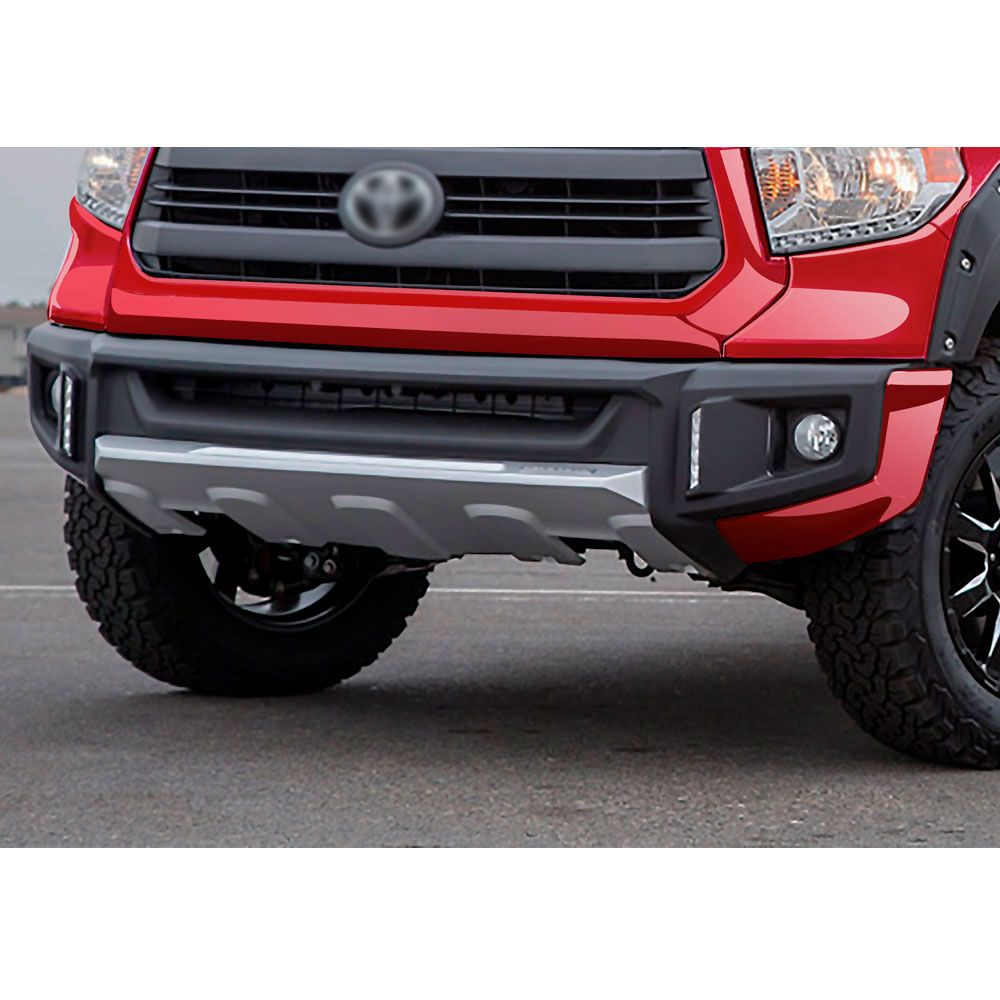
    If you want to cover the whole lower bumper and add some lighting, this unique option will definitely make heads turn. For $575, you can transform the front of your Tundra with this custom molded kit in about 40 minutes. The LED lighting that flanks the fog lights will add a truly custom feel, in addition to the skid plate-like trim on the bottom. Keep in mind that it is made of polymer, so it is not designed to take a serious beating, but if you are after looks, this could be for you.

    Front Bumpers

    Front bumpers for the Tundra come in all shapes and sizes. They generally attach to your frame, and wrap over the front of your bumper cover, or replace the bottom half of your bumper (if applicable). They are usually a few steel tubes or sheet metal welded together that are generally painted black. Some are designed with function in mind, some looks, but most keep both paired together for the best package. You can typically find these with mounting options for light bars, winches, and tow hooks, but many of them can come from the factory with these already included! 

    While some just give you the addition of a metal bumper in front of the plastic cover, some offer skid plates that help protect the expensive stuff under the truck: suspension, front engine components and accessories, and wiring. Some also offer protection above in forms of metal grills or bars around your headlights, metal grills or bars in front of the stock grill, or both.

    When shopping around, you may come across “hybrid” bumpers. These generally blur the lines between the different options for the front of your Tundra: bull bars, minimal bumpers, full face bumpers, and so on.

    Let’s take a look at some of the options out there for your Tundra.

    Slimline Hybrid Front Bumper by Southern Style Offroad

    If you want something a bit on the more “subtle” side, but still need to be ready for your weekend adventure on the trails, SSO offers their hybrid bumper. This lightweight option is made to order, so you are getting something made just for you, and not something pulled off a shelf! They take the place of the center section of your bumper, and are ready to be customized with your sourced parts. They allow the option of a winch, an included bull bar, three lighting cutout options, and a bare metal or a black powder coated finish. They run from $770 to $990.


    Addictive Desert Designs Stealth Fighter Winch Front Bumper

    If you want a complete, ready to go, fully bolt-on, made in America bumper that has everything you need and more, ADD comes in swinging with their Stealth Fighter front bumper for the Toyota Tundra. Sounds bolt, right? Well, you have the option of no winch or two different winches, no or eight different center light options, and no or three different side light options. Unlike some companies that offer cutouts for the options, this bumper comes ready to go, or you can add your own. The center section allows for a 40 inch light bar, or up to 10 cube lights. The bumper starts at $2300, but you’ll quickly go over that with options.


    Raid Armor Package Front by Ironman 4x4

    While options and sourcing parts can be fun, if you just want everything right from the factory at one up front price, Ironman 4x4 delivers just that. For just around $2000, you get a sleek bolt-on bumper that includes a 30 inch dual row LED light bar, and four cube lights. The inner cubes are clear and outer cubes amber, but you can choose if you want them to be spot or flood beams. Beyond that, you get what Ironman 4x4 says you get, which is a great complete package!


    Rear Bumpers

    Rear bumpers are a bit more simplistic, but work the same way: plastic out, metal in. Generally these replace the whole rear bumper and bumper cover. Like the front, they bolt to the frame to. They are usually visually more basic compared to stock bumpers: one color, all metal, less parts, and less flash/chrome. They are robust and designed to take a beating. Generally they are solid sheet metal, but sometimes are made out of tube steel for lighter weight.

    While they don’t typically offer taillight protection, some more expensive models can offer storage space for fuel jugs, jacks, a spare tire, and other modular storage. Since this can take up substantial room, some offer built in gates to hold all these extra items. To not disrupt the function of your tailgate, they can swing out of the way when needed.

    There may also be optional LED lighting and tow hook attachments built into the bumpers as well.

    Let’s now take a look at some of the options for the rear of your Tundra.

    Addictive Desert Designs Stealth Fighter Rear Bumper

    Coming back again it ADD, but this time they are bringing up the rear with their Stealth Fighter rear bumper. While not as many options as their front bumper, that is typical for rear bumper. You can choose between no LED lights, or four other options. The cubes will flank the sides of your license plate. It comes with integrated reinforced clevis mounts that accept 3/4" D-rings for added utility, and backup sensor cutouts are included. Before lighting options, the bumper will set you back $1700.


    Rear LED Bumper by Rough Country

    If you need quality that’s ready to go right out of the box, Rough Country offers their Rear LED Bumper. Each bumper includes two Rough Country Black-Series two inch LED Flush Mount Cubes. No need to worry about finding your own lights or price increases but choosing options. It includes everything you need for an easy installation, and also comes with a three year warranty. What’s even better is that all of that comes in at just $750.


    Raid Rear Bumper Kit by Ironman 4x4

    For another complete, flat fee bumper, Ironman 4x4 is back. Like their front bumper, they offer more lighting from the factory compared to others. While you get the four cube LED lights no matter what, you do get to choose if you want clear or red flood beams for the outer pair. The first pair are clear flood beams. While you don’t get to spec out much, you’re getting a bumper that has more lights than most, and at a flat fee of $1259.


    Push/Bull Bars (Front Only)

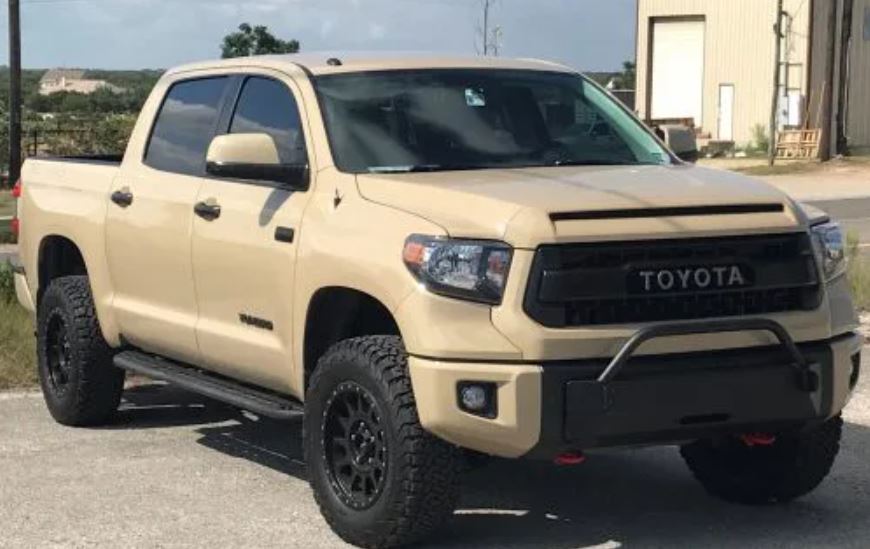
    While push bars (also known as “Bull Bars”) are not exactly considered “bumpers,” they mimic the same function of a lot of the other bumper types listed in this blog. These do come in all shapes and sizes depending on your needs, but they all offer more front protection over stock bumper covers. They can be for pushing (as the name suggests), or they are great to have another line of protection before something hits your plastic bumper cover.

    Basic models are a simple tube that comes up to right under the grill. They wrap over the bumper cover. More protective (and more expensive models) might replace the lower half of your bumper cover and cover a bit more of the grill. There is a bit of a grey area at some point with what is just a push bar, and what becomes an offroad bumper.

    As normal, let’s take a look at what is out there in terms of Toyota Tundra bull bars:

    Rough Country Bull Bar

    Rough Country has some of the most basic bull bars you can get for any truck, and that’s not a bad thing. If you just need a little extra protection up front, but don’t want to break the bank or look too much like an off-road warrior, you can’t go wrong with this simple bolt on bull bar for $200. They do offer ones that are a bit more that include LED lighting as well, but if you want simple, there ya go!


    Sportsman X Grille Guard by Westin

    For full protection of front, Westin offers this kit that mounts as a standard bull bar, but offers so much more protection. Your lower bumper is protected, your grille, and your headlights too. The heavy duty construction is backed by a three year warranty and comes with the ability to mount a 26 inch dual row LED light bar. Unfortunately, that is sold separately. This kit will show that you mean business off-road, but let’s face it... It will look good in any parking lot too. This kit costs just under $800.

    Conclusion

    A bumper, like anything on your truck, depends on the look you want, your intended use, and how much you want to spend. Our Toyota Tundras are very popular trucks, and that leads to many options. Find what works best for you, and get it on your truck!

    Image Credits

    BumperShellz - Courtesy of ecoological & Empyre Off Road

    Front Cover - Courtesy of Air Design

    SSO Front - Courtesy of SSO

    ADD Front - Courtesy of ADD & Empyre Off Road

    Ironman Front - Courtesy of Ironman 4x4

    ADD Rear - Courtesy of ADD & Empyre Off Road

    Rough Country Rear - Courtesy of Rough Country

    Ironman Rear - Courtesy of Ironman 4x4

    Rough Country Bull Bar - Courtesy of Rough Country

    Westin Brush Guard - Courtesy of 4WheelParts